
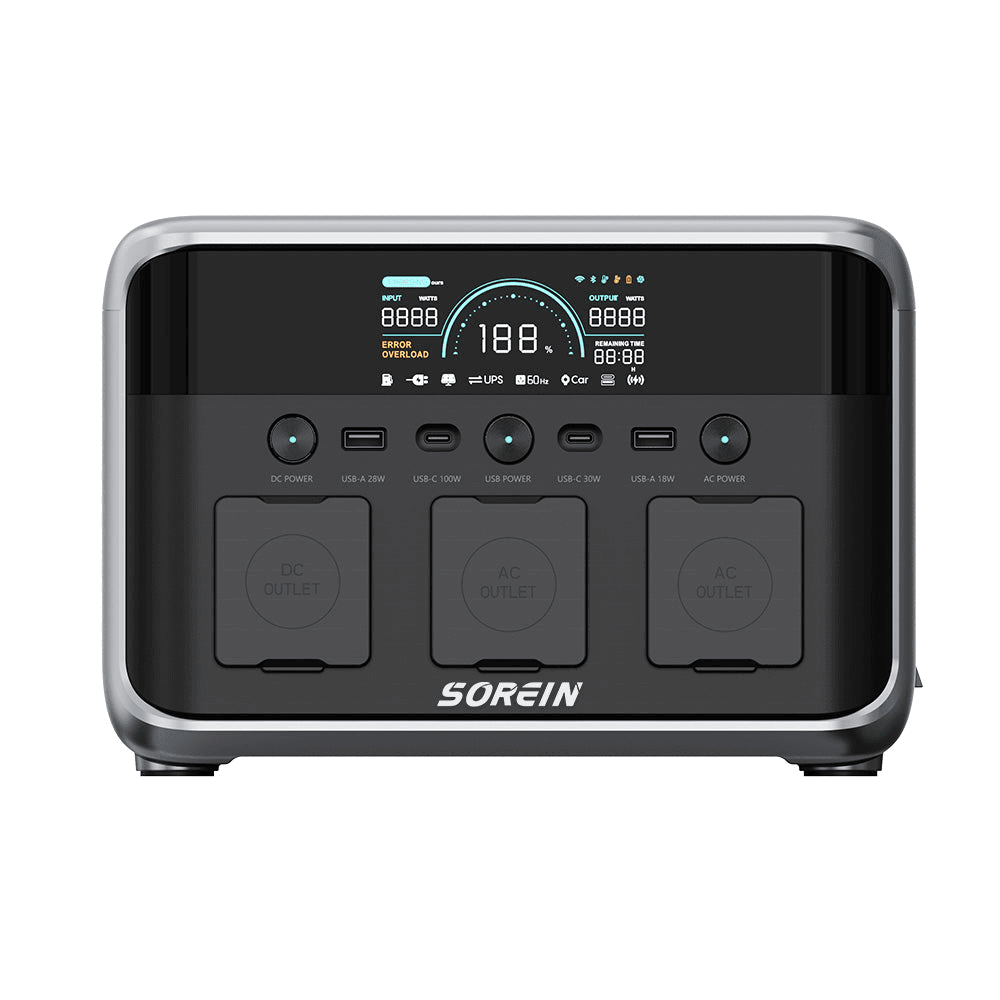
Sorein P600 Portable Power Station
$399
- 481Wh | 600W
- 1,000W peak · 2 AC outlets
- 7.5kg · 100W USB-C PD
CPAP and bedside power
Which Sorein station runs a CPAP overnight, what the machine actually draws with the humidifier on, and how to connect one at the bedside.

A CPAP machine is a small blower with a large heater attached to it. The blower holds your airway open through the night and draws less power than a laptop charger; the heated humidifier that keeps your nose from drying out is what actually drains the battery. Choose a station by what your own settings pull, not by the wattage printed on the power supply.
The hardware is just four parts: the blower unit, a water chamber, a tube and a mask. Nothing about the therapy changes here — the station only keeps the wall outlet alive when the grid does not.
These are the stations we recommend for bedside CPAP use. All three P Series models run a CPAP from a standard AC outlet, and all three output pure sine wave, which is what the blower motor and its power supply expect.
$399
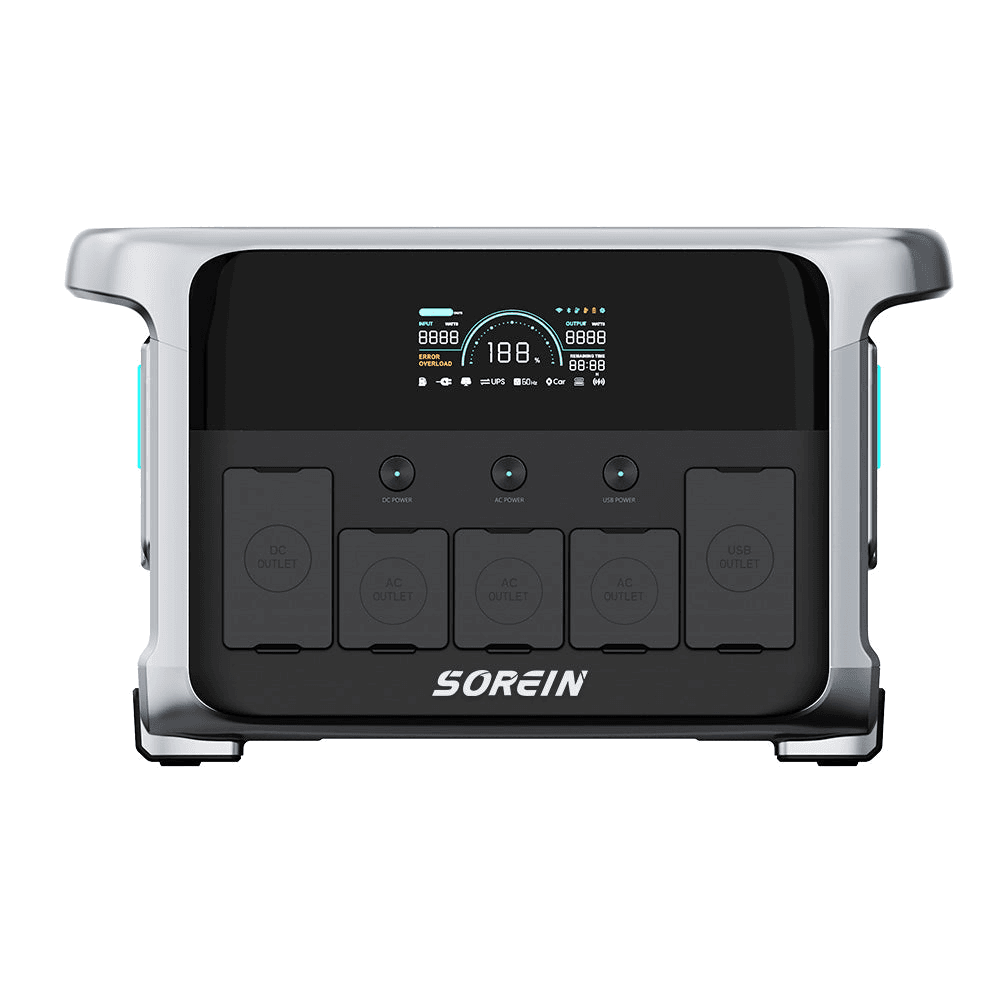
$699
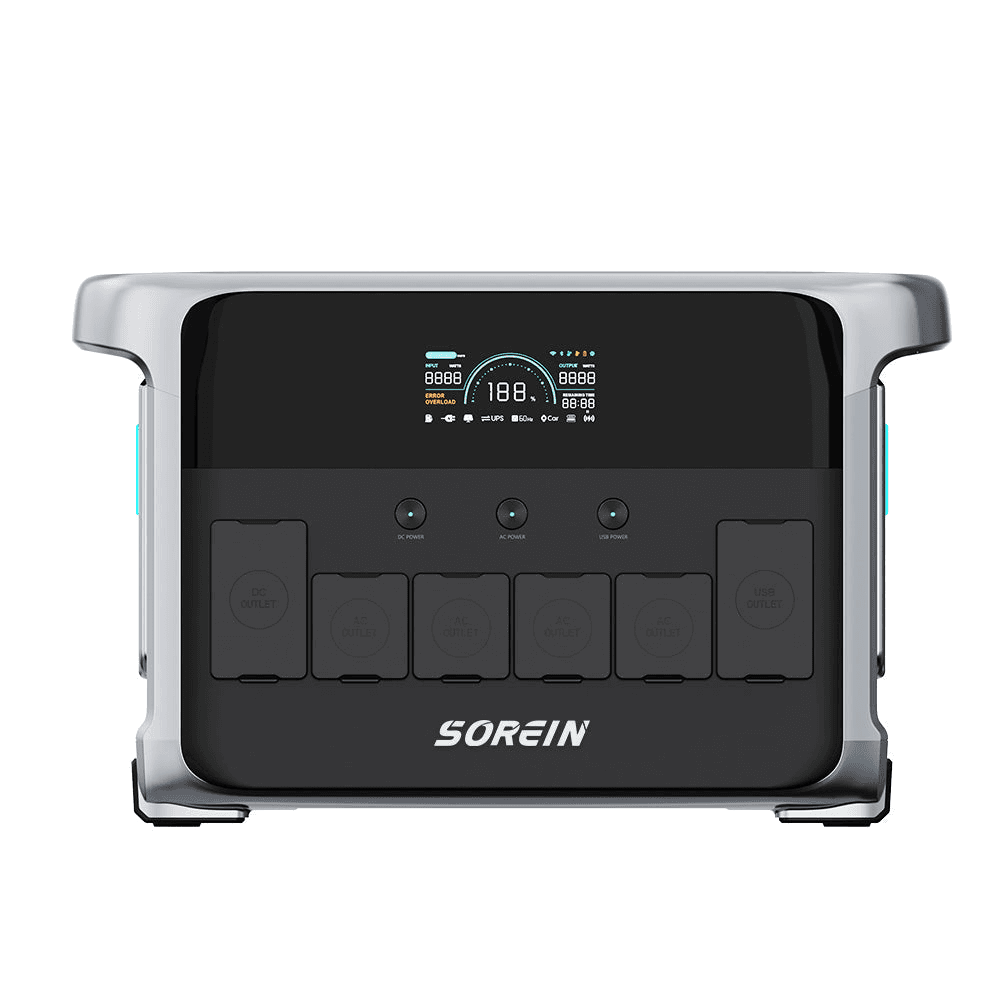
$1,099
None of them feed a 24V CPAP straight from the car socket — see the connection table below for what each path needs.
| Machine | Typical draw | Peak draw |
|---|---|---|
| ResMed AirSense 11 | 56.1W | 73.2W |
| ResMed AirSense 10 | 65.3W | 103.4W |
| ResMed AirMini (travel) | 6.3W | 27W |
The number on the power brick is the maximum the supply can deliver, not what the machine pulls: 24V × 3.75A is a 90W supply behind a machine that averages 11–57W.
At 10 cmH₂O, ResMed's battery guide works out to about 11W with the humidifier off, 28W at setting 4, 44W at setting 8 and 57W once the heated tube is added. Turning the humidifier off is the largest saving available without touching pressure, ramp or any other therapy setting.
| Setup | P600 · 481Wh | P1200 · 1,152Wh | P2400 · 2,160Wh |
|---|---|---|---|
| Humidifier off | About 4 nights | About 11 nights | About 20 nights |
| Humidifier at 4 | About 1 night | About 4 nights | About 8 nights |
| Humidifier at 8 | About 1 night | About 2 nights | About 5 nights |
| Heated tube + humidifier at 8 | Under 1 night | About 2 nights | About 3 nights |
Run one night at your normal settings before you rely on any estimate here. The percentage left in the morning is worth more than every figure on this page.
| Connection | What you need | Sorein support |
|---|---|---|
| AC outlet + the power supply that came with the machine | Any pure sine wave AC output; expect 10–20% inverter loss | P600 · P1200 · P2400 |
| 12V-to-24V DC converter | Converter cable matched to your model — AirSense 10 and AirSense 11 use different plugs | P600 · P1200 · P2400 — car socket, 120W maximum |
| Car socket on its own | Nothing, and it will not work | Not supported: 12V/10A against a 24V machine |
| EPS pass-through | Station kept plugged in at the wall, CPAP plugged into the station | P600 · P1200 · P2400 — switchover under 10ms |
The AC outlet is the simplest path and the one to use first: plug the machine into the station exactly as you would into the wall. A DC converter skips the inverter and saves 10–15%, but the cable has to match the machine, not the brand.
For longer outages, recharge by day rather than buying more battery at night: the P600 accepts up to 240W of solar, the P1200 up to 400W, and the P2400 up to 1,200W. Keep the station indoors and off the floor — cold cells lose capacity, and a cold room makes the humidifier and heated tube work harder.
Yes. A CPAP with the heated humidifier off averages about 11W, so an 8-hour night costs roughly 89Wh — the 481Wh P600 covers four nights. With the humidifier at its highest setting and the heated tube on, the same machine pulls about 57W and the night costs about 472Wh: one night on the P600, two on the P1200.
Less than the label suggests. The power brick says 65W to 90W because that is the most it can supply, not what the machine draws. ResMed's published battery figures at 10 cmH₂O work out to about 11W with the humidifier off, 28W at setting 4, 44W at setting 8 and 57W with a heated tube added.
Not directly. ResMed AirSense and AirMini machines run on 24V DC, and the car socket on every Sorein station outputs 12V/10A. Use a 12V-to-24V converter cable — matched to your model, because AirSense 10 and AirSense 11 use different plugs — into the car socket, which supplies up to 120W.
The blower moves air at 10–25W. The heated humidifier adds 15–25W and a heated tube another 10–15W. Turning the humidifier off is the single largest runtime gain available without touching the pressure your clinician prescribed.
Yes. CPAP blower motors and their power supplies expect a clean AC waveform, and a modified sine wave can make the motor run hot or buzz. Every Sorein power station outputs pure sine wave.
No. A portable power station is general-purpose backup power, not a medical device, and it is not intended for life support or monitoring. Keep the pressure settings your clinician prescribed and treat the station as a way to keep the outlet alive.