
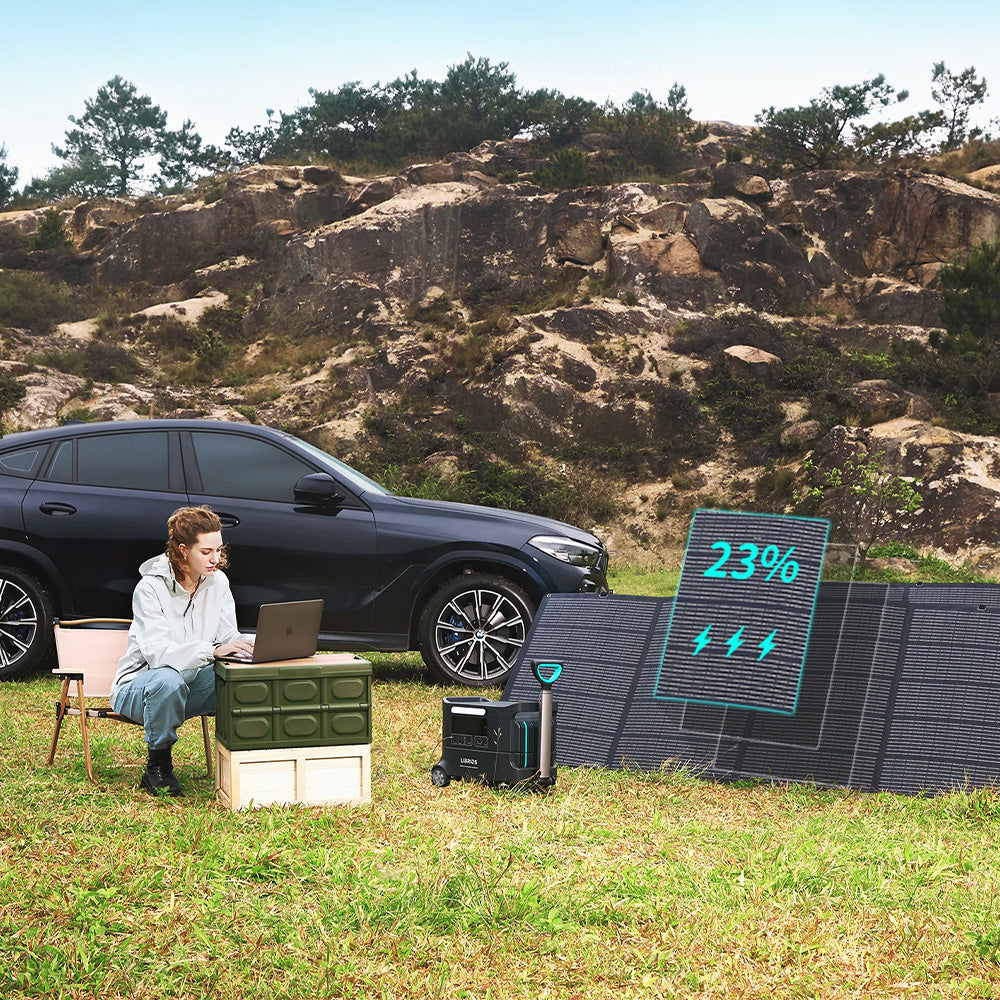
RV power splits into two jobs that need different machines. These are the stations that actually do one of them well, sorted by what you plan to run.
01
How we picked
RV power runs on two different jobs: plugging the RV's own power cord into a station, or plugging an appliance into one. The requirements differ by an order of magnitude, so the picks below are sorted by use case rather than ranked into a single list.
Five criteria decide the order:
- A 30-amp (NEMA TT-30) outlet, which determines whether whole-coach power is possible at all.
- Continuous output against startup peak, which decides whether an air conditioner, a motor or several appliances at once can start.
- Capacity against weight, which decides whether the unit gets moved or stays in the garage.
- Recharge speed, which decides how many days off-grid the system supports.
- An expansion path, which decides whether year three means another battery or another station.
02
The picks at a glance
Prices are approximate US street prices checked in October 2026, in USD. A range appears where the brand store and the retail listing sit far apart on the same unit, which is common — a station can be 30% cheaper on Amazon than on the manufacturer's site, so read a range as context rather than a quote. The two Sorein prices are live store prices and move with promotions.
| Model | Capacity | Continuous output | 30-amp outlet | Approx. price | Weight | Why it is here |
|---|---|---|---|---|---|---|
| Bluetti AC200L | 2,048Wh | 2,400W | Yes | $750–1,200 | 28.3kg | Best overall |
| Sorein G2400 | 2,400Wh | 3,300W | Yes | $1,699 | 37.5kg, splits | Best for air conditioning |
| EcoFlow Delta Pro 3 | 4,096Wh | 4,000W | Yes | $2,799 | 51.5kg | Best above 3.6kWh |
| Anker SOLIX F3800 | 3,840Wh | 6,000W | No (14-50 / L14-30) | $1,760 | 60kg | 50-amp coaches |
| EcoFlow Delta 3 Max | 2,048Wh | 2,400W | No | $1,450 | 20.3kg | Lightest 2kWh |
| Jackery Explorer 1000 V2 | 1,070Wh | 1,500W | No | $499 | 10.8kg | Most balanced 1kWh |
| Anker SOLIX C1000 Gen 2 | 1,024Wh | 2,000W | No | $570–700 | 11.3kg | Fastest recharge |
| Anker SOLIX C800 | 768Wh | 1,200W | No | $400 (list $599) | 10.5kg | Vans and tents |
| Bluetti EB3A | 268.8Wh | 600W | No | $200 | 4.6kg | Lightest entry point |
| Sorein P600 | 481Wh | 600W | No | $399 | 7.5kg | Best in the 0.5kWh class |
03
Best overall: Bluetti AC200L
What the table does not show: a 48VDC/8A RV outlet alongside a 12V/10A car socket, 0 to 80% in 45 minutes, UPS switchover within 20ms, and an expansion path to 8,192Wh.
Why it wins: in the 2kWh class it is the only unit that manages all three of "connects to the coach, takes more battery later, and can still be lifted by one person." The 45-minute recharge matters as much as the output — a lunch stop is enough to refill it, which is what separates a station you use from one you plan around.
What you give up: it is weak against a 13,500 BTU air conditioner, so plan on a soft start. Expansion runs through Bluetti's own B210, B230 or B300 packs, and a 3kWh pack costs close to what another station would.

04
Best for air conditioning: Sorein G2400
What the table does not show: a TT-30 plus four 120V outlets, a 545 × 313 × 600mm chassis, AC input up to 1,800W (about 2.3 hours to full), solar input up to 1,000W, expansion to 9.6kWh by stacking the same 2.4kWh module, and a body that separates into a 9.5kg main base and a 22kg battery.
Why it wins: the bottleneck for air conditioning is the first second, not the running load. A 13,500 BTU unit draws 1,300W to 1,500W while running but demands 4,000W to 7,000W on startup, and the 3,300W channel with a 6,500W peak is one of the few combinations in this class that clears it. A 2,400W station generally does not. The assembled weight looks disqualifying until it splits; two pieces move through an RV storage bay that one piece would not.
What you give up: recharge is roughly twice as slow as the AC200L, charging is AC or solar only with no 12V alternator input, and the unit cannot be carried assembled — loading and stowing both mean breaking it down.
One more point worth separating out: almost everything in this class seals the battery inside the case. Stations marketed as expandable are mostly hybrids — the add-on battery can be replaced, the main battery cannot, and that is the cell that fades first. The G2400's battery is itself a module: it lifts out of the chassis, can be bought or replaced on its own, and the same part stacks to reach 9,600Wh. For a system expected to run five to ten years, that is worth more than another 500Wh.

05
Above 3.6kWh: EcoFlow Delta Pro 3 and Anker SOLIX F3800
At this size the question stops being about carrying power and starts being about replacing a generator.
EcoFlow Delta Pro 3: the difference is in the outlets. It is the only unit here offering both a TT-30R and an L14-30R, so a 30-amp coach and a 50-amp coach both plug in directly with no adapter. Solar input reaches 2,600W and capacity expands to 12kWh. If one machine has to cover both kinds of RV, this is it.

Anker SOLIX F3800: built for 50-amp coaches and home backup. It has the highest continuous output in this group, but only 14-50 and L14-30 outlets — no TT-30, so a 30-amp coach needs an adapter. Solar input is 2,400W and it accepts six expansion batteries.

Both are equipment you install once and leave in place, not something to load and unload for every trip.
06
Lightest 2kWh class: EcoFlow Delta 3 Max
What the table does not show: X-Boost carries loads up to 3,400W, and UPS switchover is within 10ms.
Why it wins: 2kWh at just over 20kg is the lightest this class currently gets, and 13% lighter than the generation it replaced. If the unit has to come in and out of a compartment regularly, or payload is already tight, that gap is the whole argument.
What you give up: no 30-amp outlet, so it cannot feed the coach. Capacity cannot be expanded — that is what the weight saving bought. Solar input is capped at 500W, which makes off-grid recovery slow.

07
The 1kWh pair
Jackery Explorer 1000 V2: what the table does not show is 4,000 cycles on LiFePO4 and a retained 12V car socket. It is the most balanced unit in the class — no weak corner across capacity, output and weight — and that 12V socket matters if you run a car fridge.

Anker SOLIX C1000 Gen 2: full charge in 49 minutes, nine ports, and 80% retained after 3,000 cycles. Choose it when recharge speed and port count are the priority.

Neither has a 30-amp outlet and neither expands. Their job is clear: run appliances inside the coach, not the coach itself.
08
Lightest entry point: Bluetti EB3A
What the table does not show: a 15W wireless pad, 1.5 hours to full, and 3,000 cycles on LiFePO4.
Why it wins: the lightest unit here, close to 3kg under the P600, and the cheapest. Phones, a laptop, camera batteries, camp lights and a router run all evening without a second thought.
What you give up: enough for a light overnight load and nothing more — a car fridge is out of reach. Ports are thin: one AC outlet and four USB.

09
Best in the 0.5kWh class: Sorein P600
What the table does not show: two USB-C ports (100W and 30W), two USB-A, two DC5521, a 12V/10A car socket, a 15W wireless pad, and EPS switchover within 10ms.
Why it wins: most entry units in this class stop at 250Wh to 300Wh; the P600 carries close to double that while staying in one-hand territory. A small 12V compressor fridge runs most of a day, laptops, cameras, camp lights and a router can share it, and the 10ms EPS makes it a usable bridge when campsite power drops.
What you give up: output is a hard ceiling, so anything with a heating element is out. It is heavier than the EB3A, and for a hike-in tent setup the lightest unit is still the right answer.

10
Best for vans and tents: Anker SOLIX C800
What the table does not show: up to 1,600W under SurgePad, UPS switchover at 20ms, 58 minutes to full, and 300W of solar input.
Why it wins: the capacity lands right on one night of fridge, lights and charging for a van or tent camp; a storage cubby sits in the body and a telescopic light pole folds out of the top, which at dusk is worth more than another 300Wh. Ten ports make it the best use of space in this class.
What you give up: the output ceiling still rules out kettles and coffee makers, and there is no expansion path — what you buy is what you keep.

11
Combinations to avoid
- A 2kWh station for air conditioning. A 2,400W unit will not start a 13,500 BTU compressor unless the air conditioner has a soft start. Spend the difference there instead.
- Whole-coach power without a 30-amp outlet. An adapter does not create capacity: the coach lands on a 15-amp budget, around 1,800W total and roughly 1,440W continuous, which will not hold an air conditioner, a microwave and the converter at once.
- A sealed station bought for future expansion. The Delta 3 Max and the C1000 Gen 2 do not expand at all. If a larger battery is the plan, start with the AC200L, the G2400 or the Delta Pro 3.
- Alternator charging as a substitute for solar. A 12V/10A socket delivers about 120W, so six hours of driving returns roughly 0.7kWh — a top-up, not a refill. Dedicated DC-to-DC chargers reach 400W to 600W, but that is a vehicle modification.
- Anything above 50kg on a load-and-unload routine. The Delta Pro 3 and the F3800 are installation products, not portable ones.
Questions
Frequently asked questions
Does an RV power station need a 30-amp outlet?
Only if you want to replace shore power and run the whole coach. Feeding individual appliances through any AC outlet inside the RV works without one, and a 1kWh station covers that job. Plugging the RV's own power cord into a station requires a NEMA TT-30 outlet.
Can a portable power station run a 13,500 BTU RV air conditioner?
Read the startup figure, not the running figure. A 13,500 BTU rooftop unit draws roughly 1,300W to 1,500W while running but calls for 4,000W to 7,000W during compressor startup. A station with a 3,300W channel and a 6,500W peak can carry it; a 2,400W unit usually needs a soft start fitted to the air conditioner.
How many days will 2kWh cover in an RV?
At a typical daily draw of 1,200Wh to 2,000Wh for refrigeration, connectivity, lighting and device charging, roughly one day to a day and a half. Getting through consecutive cloudy days takes either more capacity or more solar input.
Can solar carry the recharge load on a trip?
Yes, if you plan around real output rather than the nameplate. A 400W folding panel produces about 300W to 340W at midday, so refilling 2.4kWh takes most of a clear day. Panels also need repositioning through the day; one left flat loses a large share of its rating.
Does a replaceable battery matter?
For a system you intend to run for five to ten years, yes. On a station with a sealed main battery, the day that battery fades leaves a working inverter and working outlets with no way to replace the cell that failed.