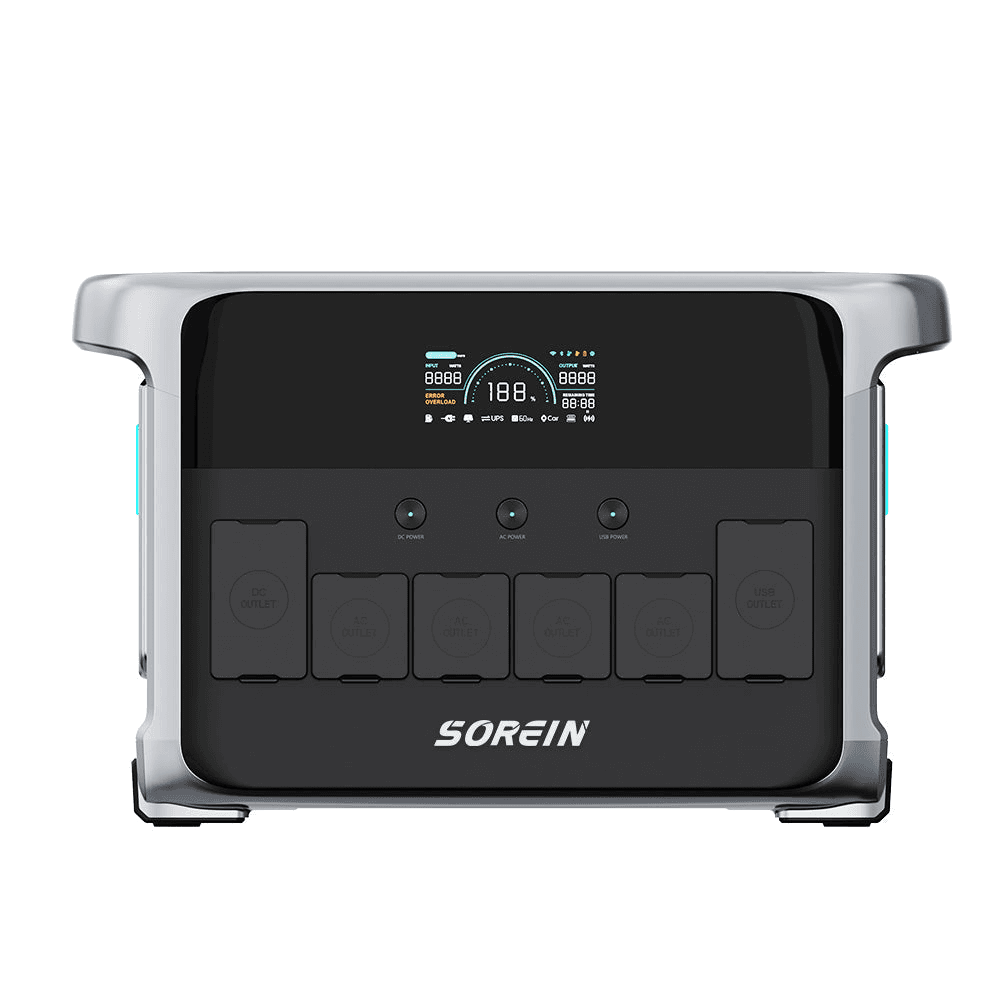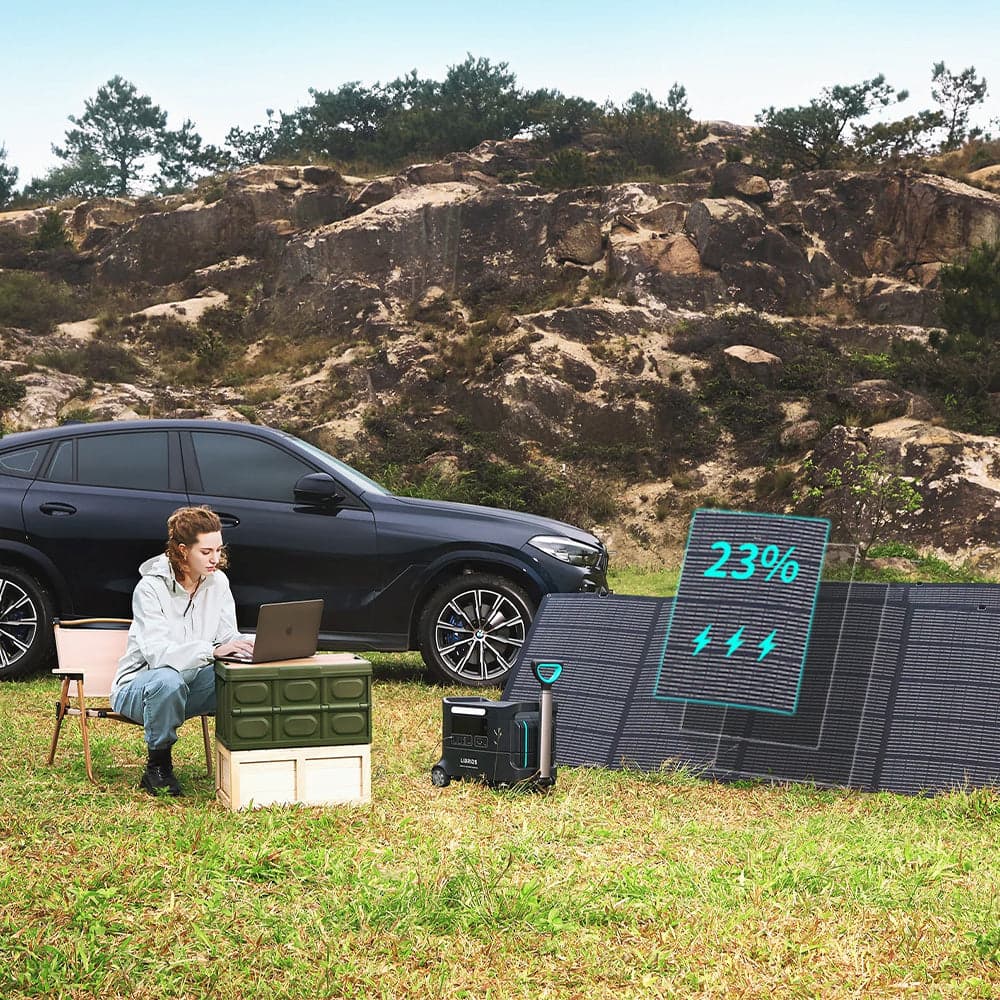
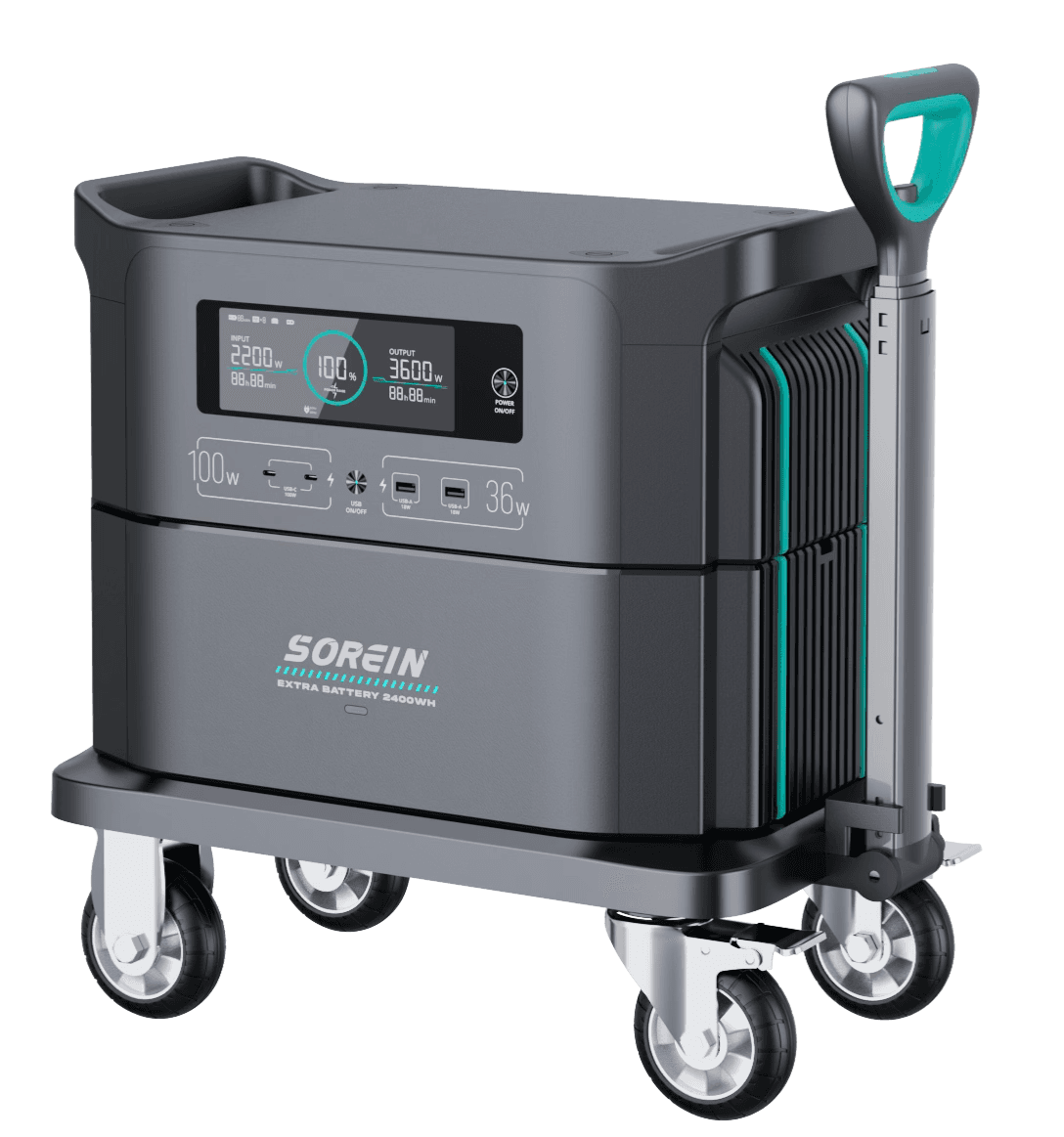
G2400 product view

Sorein G2400 Modular Power Station

One main base and one battery pack deliver industrial-grade output in the smallest G Series configuration.

Typical runtime snapshotsAt steady listed load
Refrigeration17.0 hr120W
Work lights10.2 hr200W
Water pump2.5 hr800W
Cutoff saw56 min2,200W
Capacity
2,400Wh
AC output
3,300W
Battery
48V LFP · 4,000 cycles to 80%
AC recharge
Approx. 2.3 hours
Solar plan
Up to 1,000W via main base
Best for
Construction tools, RV shore power and focused backup

Standout capabilities

  1. 01Start with one 2.4kWh battery module
  2. 023.3kW inverter channel
  3. 036.5kW startup peak
  4. 04TT-30 outlet for RV shore power
  5. 05Roll-and-stack modular platform

2,000W class

The 2,000W class, explained

A SoreinPower guide to the 2,000W-class portable power stations — how the output rating is measured, what it realistically runs, and how runtime moves as the load changes.


Full specifications

Ratings follow the published US specification; confirm the exact store listing before purchase.

G2400 — documented specifications
SpecificationValue
Capacity2,400Wh
Battery module2,400Wh · 48V LFP per module
Chemistry48V lithium iron phosphate (LFP)
Cycle life4,000 cycles to 80% capacity
AC output3,300W rated · 6,500W peak
AC outlets4 × NEMA 5-20 + 1 × TT-30
USB-A2 ports · 18W each · 36W total
USB-C2 ports · up to 100W total
AC chargingUp to 1,800W · approx. 2.3 hours
AC inlet per inverter moduleUS 1,800W · EU 2,200W · JP 1,500W
Solar chargingUp to 1,000W · 11–100V / 20A max · XT60 on the main base
Transfer time≤20ms UPS
ConnectionWi-Fi and Bluetooth · EnergyKeeper app
Size / weight545 × 313 × 600mm · approx. 37.5kg · splits into main base, battery module and chassis
Optimal operating temperature20°C to 30°C (68°F to 86°F)
Charging temperature0°C to 45°C (32°F to 113°F)
Discharging temperature−20°C to 45°C (−4°F to 113°F)
Storage temperature0°C to 45°C (32°F to 113°F)
ConstructionModular aluminum body with mobile trolley
Warranty2 years

Specifications shown are the documented configuration used for this guide. Ratings can vary by market; confirm the exact store listing before purchase.


Runtime guide

What 2,400Wh actually runs.

Estimates use 85% of listed capacity — 2,040Wh usable — divided by the stated draw. Appliances cycle, surge and change demand, so read these as planning figures rather than guarantees.

G2400 — estimated runtime by load
LoadDrawEstimated runtimeVerdict
Wi-Fi router and phones20W averageAbout 4 daysSupported
LED lighting30WAbout 2.8 daysSupported
CPAP40W averageAbout 51 hoursSupported
Household refrigerator1,200–1,500Wh a dayAbout 1.5 daysSupported
Laptop60WAbout 34 hoursSupported
TV100WAbout 20 hoursSupported
RV fridge, lights and laptop100W averageAbout 20 hoursSupported
Water pump800WAbout 2.5 hoursSupported
Cutoff saw, intermittent2,200W at roughly 50% dutyAbout 2 hours on siteSupported
Coffee maker or microwave1,000WAbout 2 hours of heatingSupported
Space heater1,500WAbout 1.4 hoursShort bursts
Central air conditioning3,000–5,000WStartup surge exceeds the 6,500W peakNot supported
Electric water heater4,500WAbove the 3,300W AC channelNot supported
Clothes dryer5,000WAbove the 3,300W AC channelNot supported
EV charging7,200W and upAbove the 3,300W AC channelNot supported

A US household averages about 29kWh a day — roughly 14× this system's usable capacity, so whole-home backup belongs to a much larger class. Check startup watts before connecting anything: the 3,300W channel is a hard ceiling, not a target.


Surge vs continuous

Starting takes 6,500W. Running takes 3,300W.

Motor-driven tools pull three to seven times their running watts for the first fraction of a second. That is the difference between starting and running: 3,300W is the continuous ceiling, 6,500W is a short burst that buys the startup.

Rated 3,300W
Held continuously. A load that stays above this trips the output, however full the battery is.
Peak 6,500W
A startup allowance at roughly twice rated. It lasts seconds — enough to cover a surge, never enough to carry a load.
One shared ceiling
Peak belongs to the whole inverter channel: chargers, lights and a second tool all draw from the same 6,500W.
G2400 — startup surge against the 6,500W peak
LoadRunningStartup surgeVerdict
Angle grinder, 4-1/2 in800W1,800–2,200WStarts and runs
Shop vacuum1,200W2,000–2,500WStarts and runs
Water pump, 1/2 HP500W2,000–3,000WStarts and runs
Demolition hammer1,500W2,500–3,000WStarts and runs
Air compressor, 1 HP1,100W3,000–4,500WStarts and runs
Circular saw, 7-1/4 in1,500W3,500–4,500WStarts and runs
Miter saw, 12 in1,500W3,500–4,500WStarts and runs
Table saw, 10 in 15A1,800W4,500–5,400WStarts, no headroom
Air compressor, 2 HP1,500W4,500–6,000WStarts, no headroom
Well pump, 1 HP at 240V1,000W4,000–6,000WStarts, no headroom
Well pump, 1.5 HP1,400W6,000–9,000WWon't start
Central air compressor3,000–5,000W9,000W and upWon't start

Surge figures vary by tool — read the nameplate startup watts or locked-rotor amps. Long extension leads, cold oil, low temperature and a partly discharged battery all push the real surge higher than the table shows.


Head to head

G2400 or P2400?

Same capacity class, two different jobs. The P2400 is a one-piece station you carry; the G2400 is a platform you stack.

G2400 against the P2400
SpecificationG2400P2400
Capacity2,400Wh2,160Wh
AC output3,300W rated · 6,500W peak2,400W rated · 4,000W peak
Cycle life4,000 to 80%3,500+ to 80%
AC full chargeApprox. 2.3 hoursApprox. 2 hours
Solar inputUp to 1,000W via the main base450W panel recommended
ExpansionAdd 2.4kWh modules, up to 9.6kWhFixed at 2,160Wh
Backup transfer≤20ms UPSNot specified
Form and weight37.5kg on a trolleyOne-piece, carried by handle

Pick the G2400 when startup surge, backup transfer or later expansion matter. Pick the P2400 when the load is simple, the budget is tighter and the station has to move every week. Both prices are live on the cards below. This is also the cheapest way into RV shore power — the same TT-30 outlet and the same 3,300W channel as the rest of the G Series — so when a stay runs past one night, the G4800 doubles the stored energy on the same outlet.

Solar recharge time

Full charge from empty on the G2400 with the panels we sell, using 85% panel-to-battery efficiency and real panel output rather than the nameplate rating.

G2400 — estimated full-charge time by panel and light condition
PanelClear middayClear, hot panelThin cloudsOvercast
200W folding panel17–19 hours20–24 hours28–47 hoursStalls
400W folding panel8.3–9.4 hours10.1–11.8 hours14.1–23.5 hours35 hours+
450W folding panel7.3–8.3 hours8.9–10.4 hours12.4–20.7 hours31 hours+

The 200W panel delivers 150–170W in clear midday sun; the 400W delivers about 300–340W. Under heavy overcast the 200W panel barely covers idle drain, so plan on the 450W panel if solar is your main recharge route — two of them halve every figure above.

The alternative, and the top-up

One complete station at a lower price, one panel that keeps this system fed between outages.

SP220 Solar Panel Solar

Sorein SP220 Solar Panel

$399

  • 220W Pmax | 18.00V Vmp · 12.22A Imp
  • 25% cell efficiency · 7.2kg net
  • Folds to 505 × 600 × 17mm
  • MC4 output · 4 adapter types included