

A portable power station for e-bike replaces the wall outlet and nothing more. Watts are rarely the problem — watt-hours decide whether you get a top-up or a full charge.
What Charging an E-Bike From a Power Station Requires
The setup is simpler than most riders expect: a portable power station for e-bike simply replaces the wall outlet, and the e-bike's own charger does the actual charging. You do not connect the battery to anything directly. The charger — the brick that came with the bike — plugs into the station's AC outlet, and the battery cable plugs into the charger. The charger manages voltage, current and shutoff exactly as it does at home.
Two numbers on the e-bike side decide everything else:
Battery watt-hours. E-bike packs are rated in volts and amp-hours, and watt-hours is just the product of the two: a 48V 10Ah pack holds 480Wh, a 48V 15Ah pack holds 720Wh, and a 48V 20Ah fat-tire or cargo pack holds 960Wh. Small folding bikes often carry a 36V 10Ah pack, about 360Wh. If the label lists watt-hours directly, use that number.
Charger draw. A standard 2A charger outputs about 54.6V × 2A ≈ 109 watts into the battery, and pulls roughly 120 watts from the outlet once its own conversion losses are counted. Faster 4A chargers deliver around 218 watts and draw a bit more. This is a light load — far below what any modern station can supply — which is why the charger's watts are almost never the limiting factor.
The temperature window matters too. Manufacturers including Bosch and Shimano specify charging only between 0–40°C. Outside that range the battery management system refuses to charge no matter how much power is available.

Why Watt-Hours Decide Whether a Station Can Charge an E-Bike
Ask whether a station can run an e-bike charger and the answer is almost always yes. Ask whether it can finish the job and the answer depends on watt-hours, because energy is lost twice on the way into the bike: once in the station's inverter (DC battery to AC) and again in the charger (AC back to DC). Planning at 80% overall efficiency keeps the math honest.
That gives one rule of thumb: a full charge takes about 1.25 times the battery's watt-hours out of the station. A 480Wh battery needs roughly 600Wh of station energy, not 480Wh.
| E-bike battery | Typical charger draw | Station energy for one full charge |
|---|---|---|
| 360Wh (36V 10Ah folding bike) | ~90W | ~450Wh |
| 480Wh (48V 10Ah commuter) | ~120W | ~600Wh |
| 720Wh (48V 15Ah trail bike) | ~150W | ~900Wh |
| 960Wh (48V 20Ah cargo / fat tire) | ~200W | ~1,200Wh |
Two things follow from that table. First, small stations in the 250–300Wh class cannot fill a 480Wh pack — they are top-up devices that might save the ride home, not charging stations. Second, charging speed never changes: a 480Wh battery on a 2A charger takes about 5–6 hours whether it is plugged into a wall or into a P2400. Bigger capacity buys more charges, not faster ones.

Tool
Portable power station size calculatorOpenHow Many Ebike Charges From P600 to G2400
The same 80% rule turns station capacity into charge counts. Usable energy is station watt-hours × 0.8, divided by the pack size:
| Power station | Capacity | Usable energy | Charges for a 480Wh pack |
|---|---|---|---|
| P600 | 481Wh | ~385Wh | ~80% of one charge |
| P1200 | 1,152Wh | ~920Wh | almost two full charges |
| P2400 | 2,160Wh | ~1,728Wh | about three and a half charges |
| G2400 | 2,400Wh | ~1,920Wh | four full charges |
The mapping is straightforward. A P600 is the trailhead top-up: it fills a 360Wh folding-bike pack completely and adds about 80% to a 480Wh commuter pack. A P1200 covers a weekend of riding for one bike, with a full charge still leaving most of a second one in reserve. For bigger 960Wh packs or two bikes, the P2400 and the modular G2400 are the realistic tier — a G2400 holds 1,920Wh of usable energy, exactly two full charges for a 48V 20Ah cargo pack.
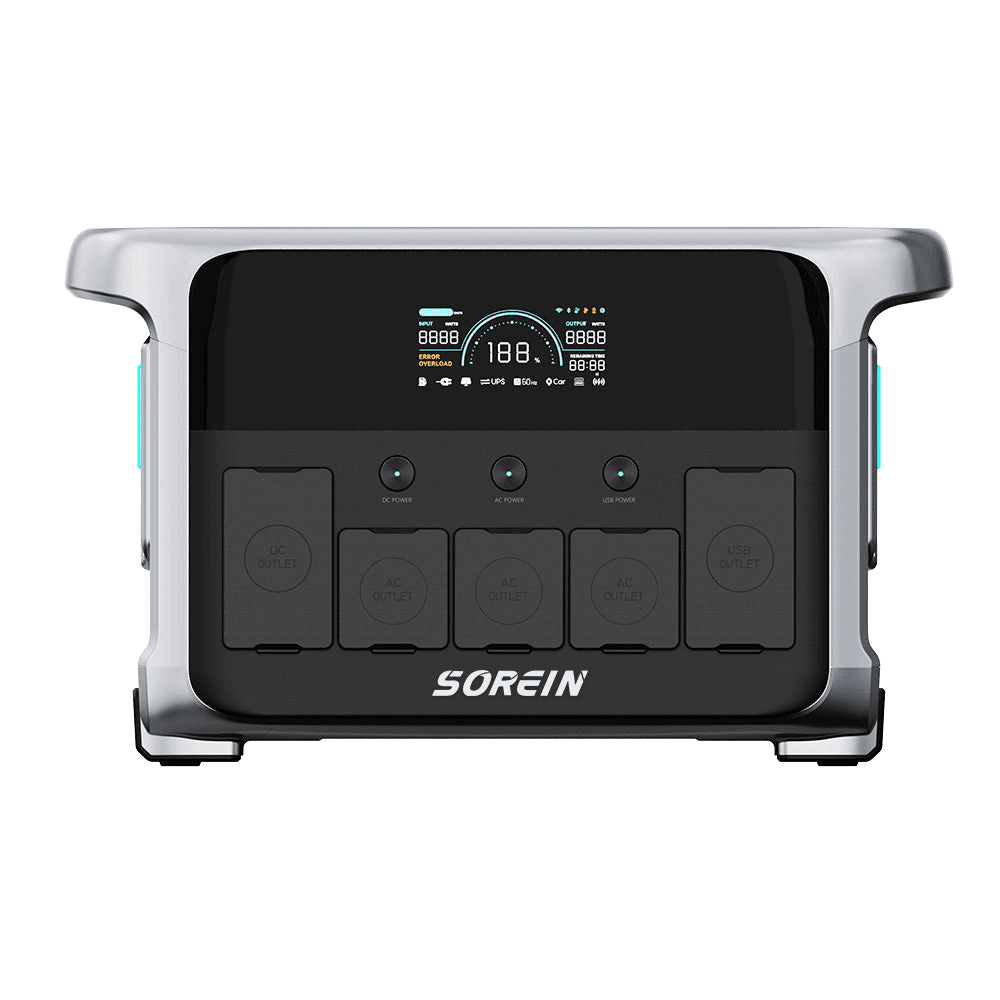
P Series
P1200- 2,000W peak · 3 AC outlets
- 100W USB-C fast charging
The same tier is what carries two bikes through a week of RV travel.

Between rides, the station itself can recover from folding solar panels — the panels charge the station, and the station runs the bike charger. On a riding day, compare the panel output you actually get against the watt-hours the bike needs; a 200W panel rarely holds its rated output for a full day. For the whole-camp power math beyond the bike, the camping power guide walks through daily watt-hour budgets device by device.

How to Charge an E-Bike From a Power Station Step by Step
- Check the battery's condition and temperature. Never charge a pack that is swollen, leaking, damaged or hot, and make sure the ambient temperature is between 0–40°C.
- Confirm the charger. Use the charger supplied with the bike or one explicitly approved for your battery system. A "universal" e-bike charger is the single most dangerous accessory in this setup — the CPSC linked mismatched chargers to 156 fire and thermal incidents between January 2023 and May 2024.
- Verify the station's output. The AC outlet must be pure sine wave (or the charger documentation must explicitly permit modified sine wave), with continuous output comfortably above the charger's draw — 300W covers every common e-bike charger.
- Check the remaining capacity. Station watt-hours × 0.8 should cover the charge you plan, plus anything else running off the station at camp.
- Connect in order. Charger into the station's AC outlet first, charger into the battery second. The charger's indicator light confirms charging has started.
- Stay nearby and disconnect when done. Do not start a charge and walk away from camp or go to sleep; lithium charging deserves attention. Unplug once the charger shows full rather than leaving the pack connected indefinitely.
Never bypass the charger. The station's DC ports and a panel wired straight to the battery are not equivalents — panel voltage swings with sun and temperature, and the bike's battery management system is not designed to regulate an external source. Solar belongs upstream, at the station.
E-Bike Charging Safety Rules for Power Station Use
The charging path is only as safe as its weakest link, and the rules are short. Charge only within 0–40°C, keep the battery, charger and station dry, stable and uncovered, and keep them away from combustible material. Look for UL 2849 certification on the e-bike electrical system and UL 2743 on the power station itself — and note that "tested to" a UL standard is not the same as certified. Stay present while charging, following CPSC guidance for micromobility batteries, and stop instantly if anything swells, leaks, smells chemical, smokes or gets unusually hot. A pack that has been charged from a power station with its own charger wears exactly like one charged at a wall outlet — the charger, not the source, defines the charging profile.
E-bike charging safety sources
Manufacturer and regulator pages cited above, verified on each organization's own site on November 25, 2026:
- CPSC — Micromobility Safety Center: lithium-battery charging guidance and the incident data behind the universal-charger warning.
- UL Solutions — E-bikes certification to UL 2849: what the e-bike electrical system standard covers.
- UL Solutions — Portable power pack testing (UL 2743): the certification path for the power station side of the setup.
- Bosch eBike Systems — Battery safety: charging temperature window, original-charger requirement and storage guidance.
- Shimano — E-BIKE battery and charger safety instructions: the 0–40°C charging range in the manufacturer's own safety manual.
Questions
Portable power station for e-bike FAQ
Can a portable power station charge an ebike battery?
Yes. A portable power station for e-bike works exactly like a wall socket: plug the bike's own charger into the station's AC outlet. Any station with a 300W or larger pure sine wave AC output can run a typical charger, which only draws about 120 watts.
How many e-bike charges can you get from one power station?
Multiply the station's watt-hours by 0.8 and divide by the battery's watt-hours. A 481Wh P600 gives about 80% of one charge for a 480Wh commuter battery, a 1,152Wh P1200 covers almost two full charges, and a 2,160Wh P2400 delivers about three and a half.
How long does it take to charge an e-bike from a power station?
The same time as from a wall outlet, because the bike's charger sets the speed. A 480Wh battery on a standard 2A charger takes roughly 5–6 hours from empty; a 720Wh pack takes 7–8 hours. A bigger power station does not charge faster.
What size power station do I need to fully charge an ebike?
Plan for 1.25 times the battery's watt-hours to cover conversion losses: a 480Wh battery needs about 600Wh of station capacity, a 720Wh battery needs about 900Wh, and a 960Wh cargo-bike battery needs about 1,200Wh.
Can I connect a solar panel directly to my e-bike battery?
No. Panel voltage changes with sunlight and the bike's battery management system is not a charge controller. Charge the power station from the panels, then run the bike's charger from the station's AC outlet.
Can one power station charge two e-bikes at once?
Only if both the watts and the watt-hours add up. Two 480Wh batteries need roughly 1,200Wh of station energy for one full charge each, which puts a 2,160Wh P2400 in range — a 1,152Wh P1200 would run out before both packs fill.
Is it safe to charge an ebike from a power station?
Yes, with the bike's own charger and a pure sine wave station. Charge between 0–40°C, keep the setup dry and uncovered, stay nearby while charging, and stop immediately if the battery ever swells, leaks, smells unusual or gets hot.
Will charging from a power station damage my e-bike battery?
No. The bike's own charger controls voltage and current exactly as it does from a wall outlet, so the battery receives the same charging profile either way.