

No fuel to buy, no exhaust to vent, no pull cord to yank. The catch is that the battery still has to be charged, and that decides what the machine can actually do.
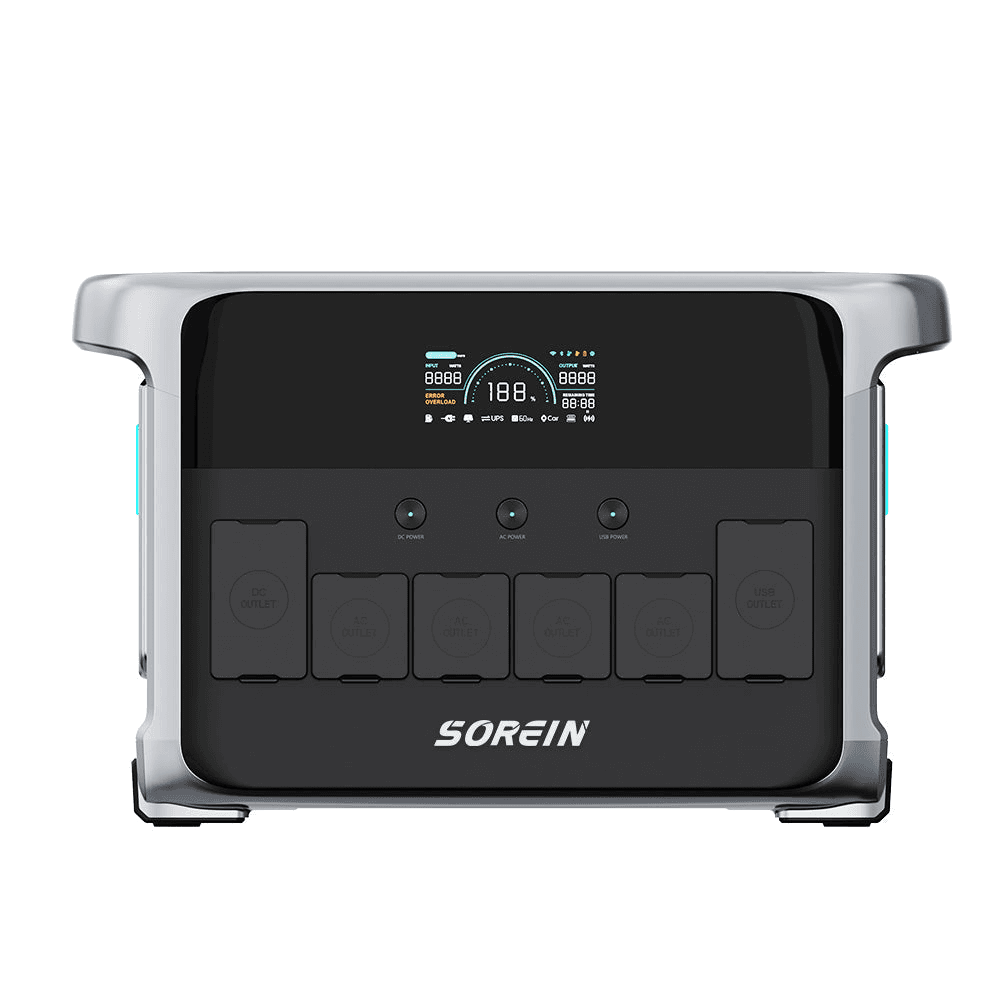
A gasless generator is a large battery in a case. Inside there is a battery pack, an inverter and a set of outlets; there is no engine, no fuel tank and no exhaust. You charge it from a wall socket or a solar panel, and it feeds a fridge, a router, a laptop or a light through ordinary AC outlets.
The one thing it does need is charging, and that is where most buyers get caught out. A 1,152Wh unit running a 1,200W load lasts 48 minutes, not because it runs out of fuel, but because 1,152 watt-hours is 1,152 watt-hours. How long it runs depends on the battery size and on whether you have a panel to refill it.
01
Is there really a gasless generator?
Yes, and the category has been on sale for about a decade. Strip one down and you find five parts: a battery pack, a battery management system, an inverter, a solar charge controller and a set of AC and DC outlets. Nothing in that list burns anything.
Which is why it never needs the four things people associate with generators.
One note on wording. "Gasless" is also the term for gasless MIG welding wire. If that is what you landed on, this is a different topic entirely.
- Gasoline, propane or natural gas: there is no fuel tank and no fuel fitting to connect.
- Oil, spark plugs or a carburetor: there is no engine to service.
- An exhaust pipe and a spot 20 feet from the house: with no combustion there is no carbon monoxide.
- A pull cord and a choke: one button and the outlets are live.
02
Which generators don't run on gas?
Plenty of products claim to run without fuel. Only one type can carry a household load, and one entry on the list below is not a real product at all.
Pages selling "magnetic generators" describe a box that produces power with no input whatsoever. That is not a device, it is a physics claim that does not hold. The test is simple: ask where the kilowatt-hours come from. If the answer is "magnets", there is no generator to buy.
| Type | Truly fuel-free? | Runs household appliances? | What it is |
|---|---|---|---|
| Battery power station | Yes | Yes, 600–6,600W | The machine this article is about |
| Solar panel plus battery | Yes | Yes | The same machine with a panel attached, not a separate category |
| Hand-crank or pedal generator | Yes | No, tens of watts | Emergency-radio territory |
| Hydrogen fuel cell | No | Partly | Hydrogen is a consumable, just in a different container |
| "Magnetic" or perpetual generator | Not applicable | Does not exist | Skip these |
03
How big a gasless generator do you need?
Two numbers decide it, and the order matters.
The first is output in watts, which sets what the machine can start. A 600W unit cannot run a 1,500W kettle no matter how much battery sits behind it.
The second is capacity in watt-hours, which sets how long it keeps going. Usable capacity is always below the nameplate figure, so we plan at 85% of rated capacity. That margin covers inverter losses and the fact that you rarely want to run a battery flat.

Tool
Portable power station size calculatorOpen04
How long will a gasless generator run?
The table is the short answer for a steady load: find the column closest to what you plan to run and read across. A cycling load such as a fridge averages lower than its running watts, so a real reading usually comes out better than the number in the table.
05
What a gasless generator will and won't run
Most of what people want to keep alive during an outage is small: a router, a laptop, a few lights, a phone. Those loads are well inside what even the smallest unit in the range can hold for a working day. The appliances that break the plan are the ones with a heating element or a motor.
Motors deserve their own line. Anything with a compressor or a spinning armature pulls two to three times its running wattage for a second or two at startup, which is why a station rated 1,200W will happily start a fridge that runs at 150W but will trip on a compressor rated at 1,000W. Heating elements are simpler: a 1,200W kettle is a 1,200W load, no surge, and it empties a small battery in half an hour.
| Appliance | Average draw | Note |
|---|---|---|
| Wi-Fi router | 10–20W | The first thing worth protecting in an outage |
| Laptop | 50–60W | Charging is intermittent, so real draw is lower |
| CPAP, no humidifier | 11W | With heating and humidification it can reach 59W |
| Full-size refrigerator | 100–200W averaged | Two to three times that on compressor startup |
| Corded drill | 600–800W | Startup surge applies |
| Electric kettle or microwave | 1,200–1,500W | Rules out anything below 1,200W |
06
Gasless vs gas: cost, noise and safety
Fuel is the obvious difference, but noise and safety decide more purchases than fuel ever does.
Measured at one metre, the loudest model in the range reaches 45.8 dB at fan gear three. That is quieter than a normal conversation, and it falls below typical room background within about two metres. A portable gas generator runs between 60 and 90 dB, which is a lawn mower you can hear from the street. The full three-gear readings at 20cm and 1m are in the noise calculator.
Tool
Power station noise calculatorOpenOn running cost, the split is wide. A mid-size gas generator burns 0.5 to 0.75 gallons an hour at half load, so at $4.00–4.50 a gallon that is $2.00–3.40 for every hour it runs. A battery unit refills from the grid for about $0.18 per full charge, or nothing at all from a panel.
| Gasless power station | Gas generator | |
|---|---|---|
| Fuel cost | None. About $0.18 per full grid charge, $0 from solar | $2.00–3.40 per hour at half load |
| Noise at 1 m | 33.3–45.8 dB measured, fan only | 60–90 dB, quiet inverter models 48–57 dB |
| Indoors | Safe, no combustion | Never. Outdoors, 20 feet from doors and windows |
| Upkeep | Dust the vents, store at 40–80% charge | Oil, spark plugs, carburetor, stale fuel |
| Runtime | Set by battery size and recharge speed | Set by how much fuel you store |
07
When you should still buy a gas generator
The price difference is real, and it should be stated plainly. A capable portable gas generator can cost a few hundred dollars, while a comparable station costs more than twice that. At $2–3 an hour in fuel, the station needs somewhere around 200 to 250 hours of runtime before the difference pays itself back. If you run a generator three times a year for a few hours, gas still wins on money.
There are also four jobs a battery unit should not be asked to do.
You need 240V
Central air, an electric dryer, an electric range, a well pump. All of these run on 240V circuits, and every portable station in this range outputs 120V. The appliance will not start, whatever the wattage on the box says.
You need more than 3kW for hours at a stretch
Inverters and battery packs derate as they heat up. Sustained high output is a thermal and chemical limit, not a defect, and a gas generator does not care about either.
The outage outlasts the sun
Three or four days of heavy cloud with no way to recharge will drain any battery. A gas generator with two cans of fuel keeps going.
You need one enormous load, once
A welder, a large air compressor, electric heat. The startup surge alone will trip a portable inverter into protection.
If none of those apply, meaning a fridge, a router, some lights, a laptop, a CPAP, a drill or a projector, the battery unit wins on noise, safety and upkeep. It is also the only one of the two you can put in the room you are sitting in.
08
Where a gas generator is not allowed at all
In plenty of places the choice is not about preference. Fuel is prohibited, so the question becomes which machine you are permitted to use.
- Apartments, condos and HOA communities: leases commonly ban fuel generators, fire codes restrict fuel storage, and balconies are usually off limits.
- RV parks and campgrounds: quiet hours typically run from 10pm to 8am, and some parks ban generators outright.
- Indoors, garages included: even with the door open, a gas generator cannot run in there.
- Overnight medical equipment: a CPAP or oxygen concentrator has to sit beside the bed and run with no emissions at all.
- Offices, server rooms and food service: many commercial leases state that no fuel may be stored on the premises.
09
Which model fits
For an overnight outage, a bedroom, or anything that has to stay quiet, P1200 at 1,152Wh and 1,200W covers a fridge, a router, lights and a CPAP, and P2400 doubles the capacity if the fridge has to run for a full day. For a phone, a camera, lighting and a single CPAP, P600 is enough. For power tools, or for plugging an RV into shore power, G2400 adds a 3,300W output and a TT-30 socket.
To check your own setup rather than a typical one, list the devices in the power station calculator and it returns capacity, inverter size and runtime.
- Add up the running watts of everything you want to power, and multiply motor loads by two or three.
- Compare that total with the output rating, and drop any model that cannot start the largest load.
- Divide your daily watt-hours by 0.85 to get the capacity you need, then add panels if an outage might outlast the battery.
Questions
Frequently asked questions
Can you have a generator without natural gas?
Yes. Natural gas generators need a connection to a utility gas line, which limits them to permanently installed standby units. A battery power station needs no gas line at all, because it charges from a wall outlet, a solar panel or a car socket.
What generator does not run on gas?
Battery power stations are the only type you can buy today that carries a household load without fuel. Hand-crank generators exist but produce tens of watts. Hydrogen fuel cells still consume a cartridge, so the fuel is simply in a different container.
Is a gasless generator the same as a solar generator?
Mostly. A solar generator is a power station plus one or more solar panels, so it is still a battery machine. The difference is how it refills: every gasless unit can charge from a wall outlet, and only the ones with a solar input can also charge from panels.
How long can a gasless generator run?
Runtime is capacity divided by load. A 1,152Wh station gives about 979Wh of usable capacity, which is roughly 9.8 hours at 100W, 3.3 hours at 300W and 1.6 hours at 600W. Running a CPAP at around 11W, the same unit lasts several nights.
Can a gasless generator power a whole house?
No. Portable battery units top out around 6,600W and most have no 240V output, so a whole-panel backup needs a permanently installed battery system or a standby generator with a transfer switch.
Do gasless generators need maintenance?
Very little. There is no oil, no spark plug and no air filter. The only routine care is storing the battery between 40% and 80% when the unit sits unused, and keeping it out of prolonged heat.
Are gasless generators safe to use indoors?
Yes. With no combustion there is no carbon monoxide, which is the reason gas generators have to stay outside. Leave clearance around the vents so the fan can move air, and use the charger that came with the unit.