

A portable power station can run a window air conditioner if three numbers line up: running wattage, startup surge, and battery capacity. A 1,200W station carries a 5,000 BTU unit, 2,400W covers 8,000–10,000 BTU, and central air is out of reach at any size.
Which Air Conditioners a Power Station Can Run
A battery power station — also sold as a gasless generator — has no engine and no fuel tank. The limits below come from the inverter and the battery, not from combustion.
BTU is cooling capacity, and it maps to room size.
More cooling capacity means more power draw. Size the unit to the room rather than buying big — an oversized AC cools the room too fast, short-cycles, and drains a battery faster than a properly matched one.
- 5,000 BTU — a small bedroom of 150–250 sq ft
- 8,000 BTU — a 300–450 sq ft master bedroom
- 10,000 BTU and up — living areas of 450+ sq ft
Why the Power Station Shuts the Air Conditioner Off at Startup
When the compressor kicks on, an air conditioner pulls two to three times its running wattage for 0.2–0.5 seconds. Most portable stations hold their peak rating for only about 0.3 seconds, so a surge that lands just under the peak can still trip overload protection. The peak needs clear headroom, not a photo finish.
Two things matter here:
Test the pairing once while the grid is still up — do not let an outage be the first time you try it.
- A bigger battery does not fix startup tripping. Whether the unit starts depends on peak output; how long it runs depends on capacity. They are independent thresholds.
- There are three ways past a tripping startup. Move down one AC size; fit a soft start kit to the unit (around fifty dollars, cuts the surge by more than half); or choose an inverter air conditioner, which ramps up gently and draws close to its running wattage at startup.
How to Calculate Battery Runtime
Runtime follows one estimate: battery capacity ÷ running wattage = hours, then multiply by 0.85 for conversion losses.
Those are worst-case numbers — a hot afternoon with the compressor running flat out. Overnight the compressor sits idle roughly half the time, which nearly doubles the runtime: about 3.5–4 hours on a P1200 with a 5,000 BTU unit, and around 7 hours on a P2400. A full eight-hour night takes roughly 2kWh of usable energy, so overnight cooling lands on the P2400 rather than the smaller unit.
The working pattern is to pre-cool the room and top off the station while grid power or solar is available, then let the battery carry the night.
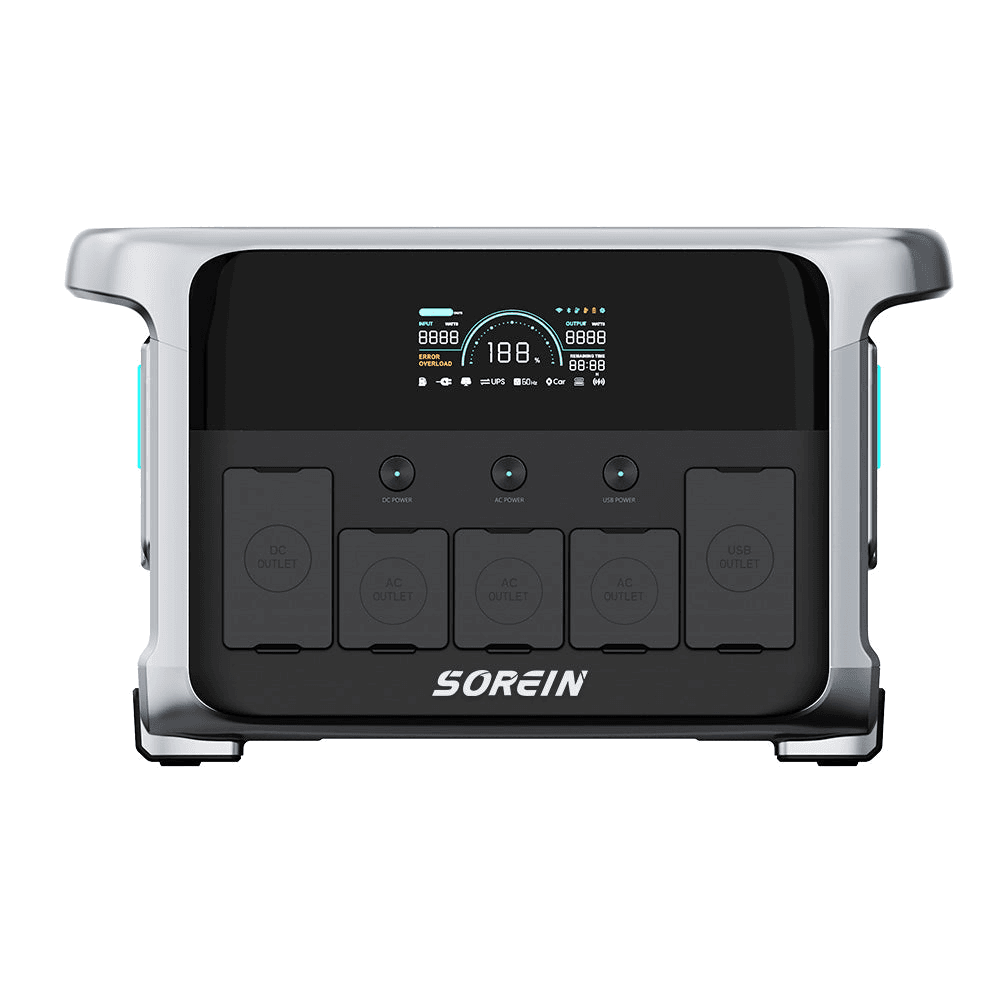
P Series
P1200- 2,000W peak · 3 AC outlets
- 100W USB-C fast charging
| Your air conditioner | Typical draw | P1200 (1,152Wh) | P2400 (2,160Wh) |
|---|---|---|---|
| 5,000 BTU window unit | ~500W | about 2 hours | about 3.5 hours |
| 8,000 BTU window unit | ~700W | may not start — surge dependent | about 2.5 hours |
| 10,000 BTU window unit | ~1,000W | may not start — surge dependent | about 1.8 hours |
What Size Power Station You Need
A 1,000W station will keep a 5,000–6,000 BTU unit running, but it sits close to its peak ceiling at startup. The 1,200W column is the comfortable floor, not a hard minimum.
For a precise figure, multiply the AC's nameplate wattage by the hours you need and divide by 0.85, then keep a 20% margin. If the nameplate only lists amps, multiply by 120 to get watts. Or list the appliances you plan to run in the power station calculator and it works out the capacity for you.

Tool
Portable power station size calculatorOpen| Your air conditioner | Station output | Battery capacity | Sorein match |
|---|---|---|---|
| 5,000 BTU window unit | 1,200W | ~1,000Wh gives 3–4 hours; 2kWh for a full night | P1200 (P2400 for overnight) |
| 8,000–10,000 BTU | 2,400W | 2kWh and up | P2400 |
| 10,000 BTU and above | 3,300W | expand with battery modules — runtime follows capacity | G Series |
| Central air | — | — | none |
How to Make the Power Station Run Longer
- Pre-cool before the outage. Holding a room at temperature costs far less than cooling it down from 90°F.
- Cut the heat load. Close curtains and interior doors, and block direct sun.
- Raise the set point. Each degree higher on the thermostat trims cooling energy by roughly 3%.
- Add a fan. A fan draws just 40–60W, so the same battery runs it for 10+ hours. Let the AC pull the temperature down and the fan hold the comfort level — the best combination on battery power.
- Stop with charge to spare. Park it at 20–30% remaining: easier on the battery, and it leaves headroom for phones and lighting.
What Not to Do
- Do not run an air conditioner on a modified sine wave inverter. Compressors run hot, growl, and sometimes refuse to start on it. When buying a station, confirm the output is pure sine wave.
- Do not use a long, thin extension cord. An air conditioner is a high-current load, and undersized wiring heats up and drops voltage. Plug directly into the station's AC outlet when possible; if a cord is unavoidable, keep it short and heavy-gauge.
- Never backfeed the station into a wall outlet to power the house. It endangers utility crews working the line and destroys the unit. The AC plugs into the station's outlet, and that is where it stops.
- Do not attempt central air. The wattage, the surge, and the 240V service are all beyond what a portable power station delivers — that scenario belongs to a fuel generator or a home battery system.
Questions
Frequently asked questions
Will a 1,000W power station run a window air conditioner?
Some of them. A 5,000–6,000 BTU window unit draws 400–600W while running, so a 1,000W station can carry the load — but the startup surge may push against its peak ceiling. Whether it works depends on the specific unit, so test it before an outage. Anything above 8,000 BTU is not worth attempting.
Why does my power station shut off the moment the AC starts?
The compressor startup pulls two to three times its running wattage for 0.2–0.5 seconds. If that spike crosses the station's peak output, it trips into overload protection. That is not a defect — the surge simply exceeded the ceiling. Fix it with a smaller AC, a soft start kit, or an inverter-driven unit.
Does a bigger battery mean the AC runs longer?
Runtime scales with capacity, but only once the station can start the unit. Startup depends on peak output, not stored energy — if the peak is too low, even a huge battery cuts out the instant the compressor kicks on.
Portable AC or window AC — which is better on battery power?
The window unit. For the same cooling output, a portable AC burns 20–30% more electricity because part of its exhaust hose sits inside the room. If a window unit can be installed, it wins every time on battery.
Can a portable power station run central air?
No. Central air runs on a hardwired 240V circuit and needs 2,000–5,000W continuous, with startup surges above 8,000W. A portable power station outputs 120V, so it cannot be connected at all. Keeping central air alive is a job for a home battery system or a standby generator; what most people do instead is run one room off a 5,000 BTU window unit.
Are inverter air conditioners really more efficient?
Yes, in two ways. While running, the compressor modulates its output instead of cycling at full power. At startup it ramps up gently, so the surge stays close to running wattage and rarely trips the station's protection. On battery power, an inverter unit is the strongest option across the board.