

Sorein 200W Foldable Solar Panel SP200
$299
- 200W Pmax | 18V Vmp · 11A Imp
- 25% cell efficiency · 7.2kg net
- Folds to 505 × 600 × 17mm
- MC4 output · 4 adapter types included
Unfold a solar sheet at camp, point it at the sun and recharge any 12V-class power station off-grid — no roof mounting, no wiring.
$299

$399
$499

$599
A 12 volt folding solar panel is a portable solar sheet that folds flat for storage and opens into a full-size panel at camp — the standard way to recharge a 12V-class portable power station off-grid.
No roof mounting, no wiring: unfold the panel, aim it at the sun and connect it to the station's solar input, and the station's MPPT controller handles the rest.
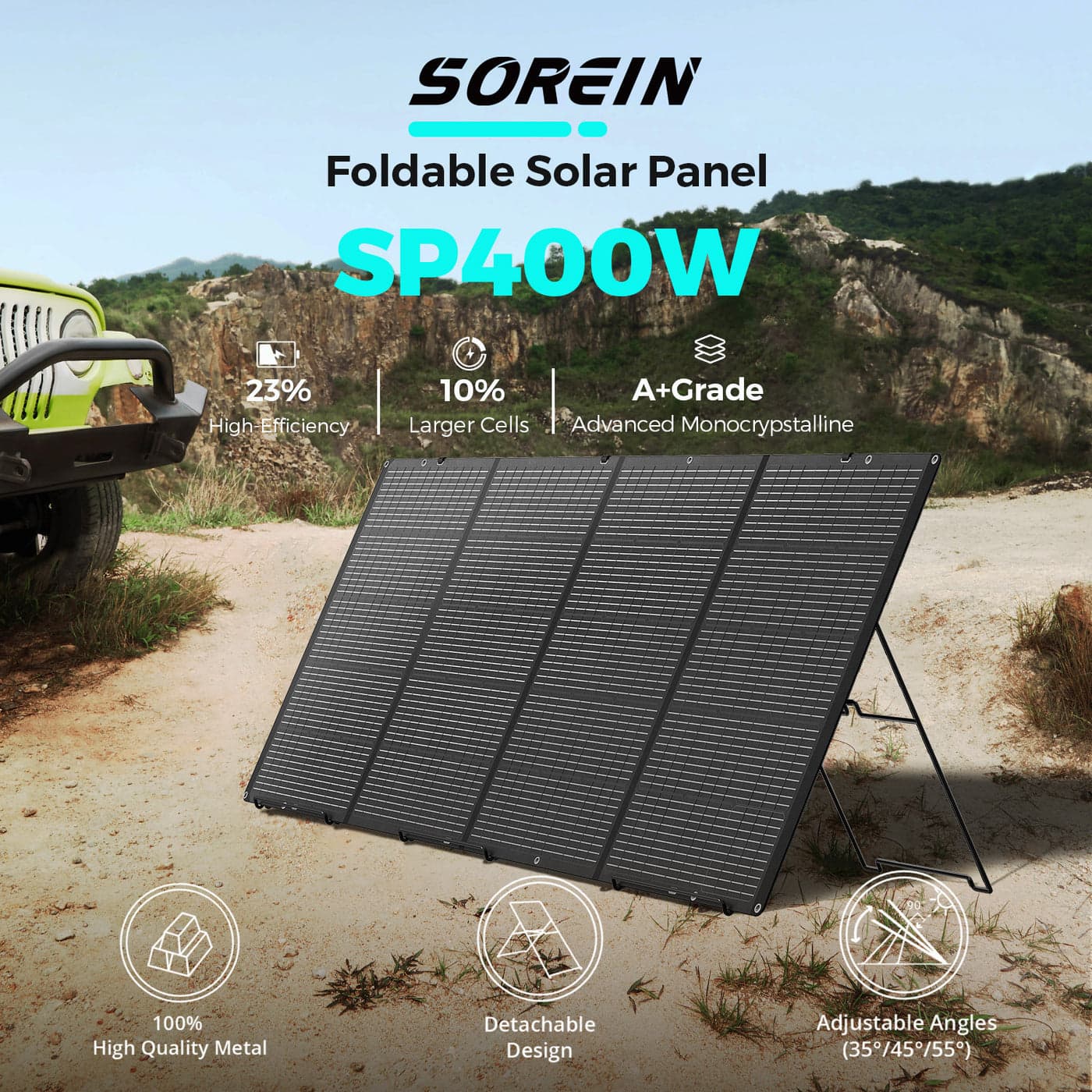
SoreinPower builds them in two sizes — a 7.2 kg sheet sized for day trips and camper trunks, and a 14.4 kg sheet for basecamp and faster refills.
Every panel outputs through weatherproof MC4 connectors and ships with adapters for all four common station inputs, so it works with your station out of the box and still fits a larger bank when you upgrade later.
Daily energy depends on two things: the panel's wattage and the sunlight it actually receives. The planning formula is daily energy (Wh) = panel watts × peak sun hours × 75–85% system efficiency. Peak sun hours are equivalent hours at full reference irradiance — not daylight hours — and most campsites see three to five of them on a clear day.
| Peak sun hours | 200W / 220W panel — estimated daily energy | 400W / 450W panel — estimated daily energy |
|---|---|---|
| 2 hours — overcast or low winter sun | 150–170Wh | 300–340Wh |
| 3 hours — partly cloudy | 225–255Wh | 450–510Wh |
| 4 hours — a good clear day | 300–340Wh | 600–680Wh |
| 5 hours — strong summer sun | 375–425Wh | 750–850Wh |
| 6 hours — long midsummer day | 450–510Wh | 900–1,020Wh |
These are planning estimates, not guaranteed output. Nameplate watts are laboratory STC figures — in the field a 200W SoreinPower sheet measures 165–190W squared to the sun, and cloud cover, panel angle, heat and partial shade all trim the total further.
Applied to real stations: a 200W panel in good sun refills a P600 (409Wh usable) in roughly 2.5–3 hours, while a 400W panel covers most of a day's recharge for a P1200 and still sits inside its 400W solar input ceiling. For the station-by-station charging table, see the full solar panel specifications, or run your own numbers in the solar panel calculator.
Unfold where the sun is. Stable ground, no shade from the vehicle, awnings or roof racks, panel angled at the sun. A strip of shade across one section can cut output hard — if the campsite is shaded, run the cable: the panel goes where the sun is and the station stays where it is.
Plug straight into the station. Every SoreinPower station carries its own MPPT charge controller behind the solar input, so there is nothing extra to buy or wire — pick the included adapter that fits (DC5521, Anderson, XT60 or Aviation M16) and charging starts. Charging a bare 12V battery is the exception: that setup needs an external controller between panel and battery.
Check the voltage window before chaining. Two 200W panels in series land near 36V, two 400W panels near 72V — both inside the 11–100V MPPT window SoreinPower inputs accept. Series adds voltage and parallel adds current; either way, the combined string stays under the station's input ceiling.
Confirm charging at the display. Check the station's input wattage after setup. Output starts low in weak sun and climbs as you re-aim the panel, and a reading below the nameplate is normal — nameplate watts are laboratory numbers. An unusually low reading usually means shade, a loose connection or the wrong angle, not a fault.
Dry it, then fold it away. Disconnect in the order the manual gives, let a rain-soaked sheet dry before it goes back in the case, fold the hinges without forcing them and keep the cables clear of the creases. Panels stored damp age fast; panels stored dry last the decade.
Six avoidable mistakes turn a portable kit into shelfware. Every one of them costs nothing to check against the spec sheet before you order.
Read the panel's Vmp and Voc — a 12V-class panel runs 20–24V at max power and higher open-circuit. What matters is the receiving device's input window, not the label.
STC watts are laboratory numbers. A 200W SoreinPower sheet measures 165–190W in the field; use that figure for recharge estimates and panel counts.
Series wiring adds voltage: two 200W panels near 36V, two 400W near 72V. Add the string's Voc up and keep it under the station's input ceiling — on SoreinPower inputs, 100V.
A plug that fits is not a wiring match. Confirm polarity and voltage before connecting; the four included adapters (DC5521, Anderson, XT60, Aviation M16) cover the common station inputs.
A strip of shade from the vehicle, an awning or a cable can cut output hard. Put the panel in open sun and let the cable reach — the station itself can sit in the shade.
Moisture trapped in a folded case is what ages a panel. Dry the sheet and cables before storage, and fold the hinges without forcing them.
Controllers, output expectations, chaining panels, weather resistance, adapters and how folding differs from flexible panels.
Not with a SoreinPower station. Every station carries its own MPPT charge controller behind the solar input, so the panel plugs straight in. Charging a bare 12V battery is the exception — that setup has no built-in electronics and does need an external controller between panel and battery.
"12V" describes the battery class the panel charges, not its terminal voltage. A lead-acid battery needs charging voltage above its nominal voltage, and a panel rated for that job runs higher — typically 20–24V Vmp with an even higher open-circuit voltage (Voc). Solar input windows on 12V-class stations accept this: SoreinPower inputs take 11–100V. Check the panel's Vmp and Voc against the receiving device's input range rather than the marketing label.
With four peak sun hours and a 75–85% system-efficiency factor, roughly 300–340Wh per day. Peak sun hours are not daylight hours — they are equivalent hours at full reference irradiance, and most campsites see three to five on a clear day. Nameplate watts are laboratory STC figures; in the field a 200W SoreinPower sheet measures 165–190W squared to the sun, so plan around that number.
Yes, in series. Two 200W panels land near 36V and two 400W panels near 72V — both inside the 11–100V MPPT window SoreinPower stations accept. Series wiring adds voltage, parallel wiring adds current, and the combined string must stay under the station's input ceiling. Confirm the Voc of the full string before you plug it in.
The sheet is built for outdoor use — an ETFE laminated surface with weatherproof MC4 output connectors — but weather resistance is not a licence to store it wet. Let a rain-soaked panel dry before folding it into its case, and keep the adapter cables dry at the connection point. Long-term exposure to standing water is outside any portable panel's design.
DC5521, Anderson, XT60 and Aviation M16 cables ship in the case. Between them they cover the solar inputs found on small stations, mid-size units and larger battery banks, so the same panel charges your first station out of the box and still plugs into an upgraded setup later.
Folding panels use hinged sections made for daily deployment — carry them, open them, aim them, fold them away. Flexible panels bond flat onto curved or fixed surfaces and have a stated maximum bending limit; they are not built to be folded repeatedly. If the panel moves camp to camp, you want a folding panel; if it lives on a roof or a van, that is flexible-panel territory.
Match the panel's daily yield to the station's capacity and input window. A 200W panel refills a 481Wh station in 2.5–3 hours of good sun; a 400W panel suits 1kWh-class batteries and keeps two-panel setups tidy. The station-by-station pairing table lives on the main solar panel page, and the solar generator kits ship the already-matched pair.