
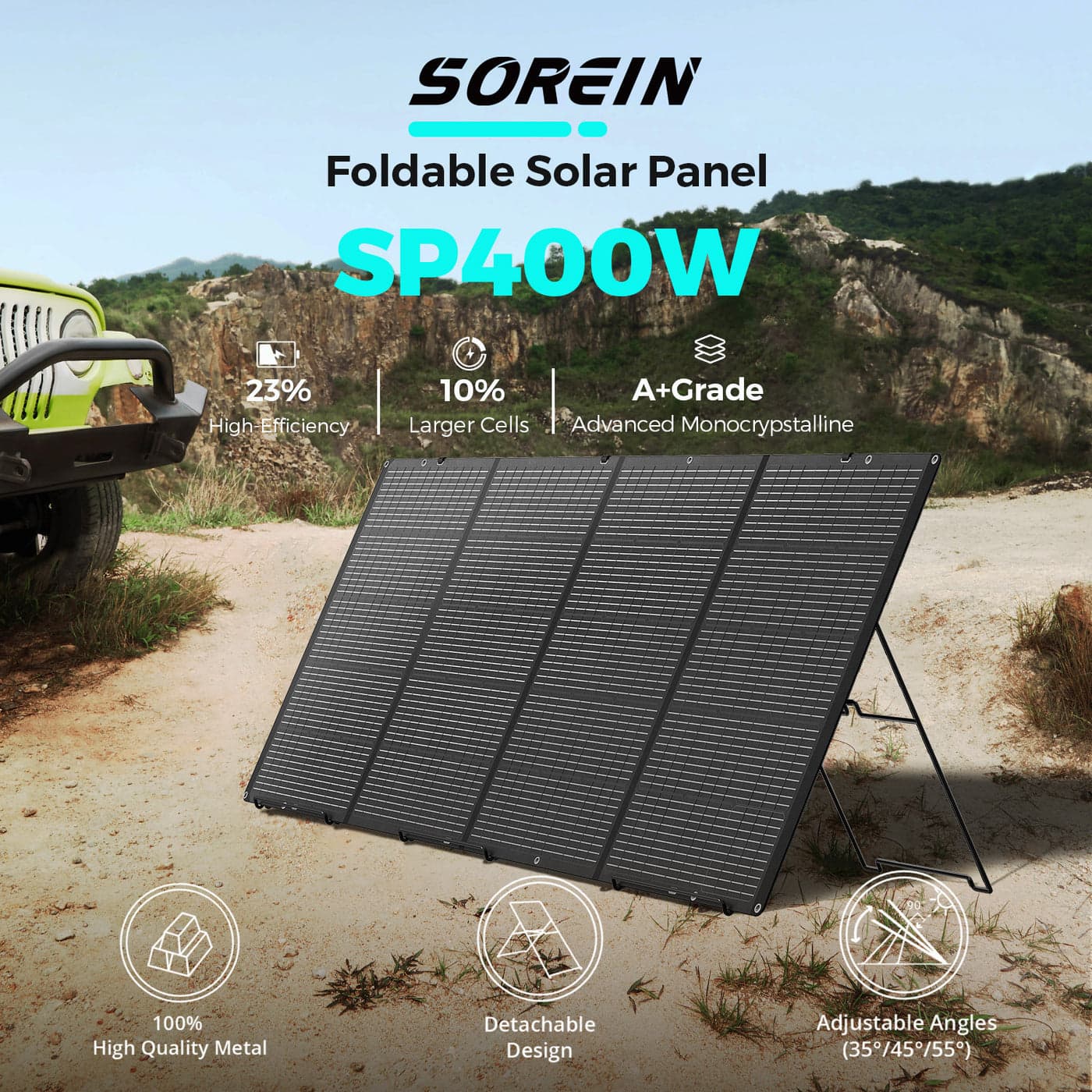
Sorein 400W Foldable Solar Panel SP400
$499
- 400W Pmax | 36V Vmp · 11A Imp
- 25% cell efficiency · 14.4kg net
- Folds to 620 × 982 × 35mm
- MC4 output · 4 adapter types included
Two folding panels cut from the same 2,510 × 982 mm sheet — 400W and 450W — with the daily yield, the wiring limits and the stations that accept the full output.
Two SKUs on one sheet size: the SP400 and the SP450 differ in cell batch, not in frame, folded size or weight.
$499

$599
Daily energy is rated watts × peak sun hours × 0.7 real-world efficiency. Peak sun hours are equivalent hours at full reference irradiance rather than daylight hours, so a clear campsite gives you three to five of them and a bright midsummer day six.
The 0.7 combines two losses. The first is 0.8 for real output: in clear midday sun the SP400 measures 300–340W squared to the sun instead of its 400W nameplate, and the SP450 measures 340–385W instead of 450W — heat, angle and partial shade are what pull that down. The second is 0.85 for panel-to-battery charging efficiency. Multiplied out that is 0.68, rounded to 0.7 here, which is why the solar panel calculator returns roughly 1,090Wh for the same panel and the same four hours of sun while the table below says 1,120Wh.
Both panels are the same 14.4 kg sheet with the same folded size, so the 450W earns its extra cost only where the station can actually collect it — the P2400 and the G Series upward.
Estimated output on a clear day, using the measured field band and a 0.7 planning factor. These are planning figures, not guaranteed output.
| Peak sun hours | SP400 · 400W — estimated daily energy | SP450 · 450W — estimated daily energy |
|---|---|---|
| 2 hours — overcast or low winter sun | 560Wh | 630Wh |
| 3 hours — partly cloudy | 840Wh | 945Wh |
| 4 hours — a good clear day | 1,120Wh | 1,260Wh |
| 5 hours — strong summer sun | 1,400Wh | 1,575Wh |
| 6 hours — long midsummer day | 1,680Wh | 1,890Wh |
Four peak sun hours is the row to plan with: a P1200 holds 1,152Wh, so a single SP400 lands just under a full refill in one clear day at 1,120Wh, while a P2400 at 2,160Wh needs two panels or two days. For the station-by-station recharge table see the solar panel pairing page, or run your own numbers in the solar panel calculator.
A 400W panel is only worth its rating on a station that can take it. Only the P600 caps input below the panel's rating, at 240W; the P1200's 400W ceiling sits level with the SP400's rating, so the full output still lands. Running a pair is where it gets fiddly — voltage blocks it on some models, current on others.
| Station | Solar input | One SP400 | Two SP400 |
|---|---|---|---|
| P600 · 481Wh | MPPT · 12–50V / 12A · 240W ceiling | Capped at 240W | No — 72V series breaks the 50V limit, 22A parallel breaks 12A |
| P1200 · 1,152Wh | MPPT · 12–60V / 12A · 400W ceiling | Full output accepted | No — 72V series breaks the 60V limit, 22A parallel breaks 12A |
| P2400 · 2,160Wh | MPPT · 12–60V / 25A · 1,200W ceiling | Full output accepted | Parallel only — 800W at 22A, inside the 25A ceiling |
| G2400 · 2,400Wh | MPPT · 11–100V / 20A · 1,000W ceiling | Full output accepted | Series only — 72V at 11A, inside the 100V window and the 20A ceiling |
| G4800 · G7200 · G9600 | MPPT · 11–100V / 20A · 1,000W ceiling via main base | Full output accepted | Series only — 72V at 11A; a third panel would reach 108V |
Input windows are the published figures for each station, not test results: the G Series accepts 11–100V at up to 20A and 1,000W through the main base, while the P Series caps lower. Two 400W panels in series add voltage to roughly 72V and leave current at 11A; two in parallel add current to 22A and leave voltage at 36V. That is why a pair works one way on a G Series and the other way on a P2400, and not at all on a P1200.
Start with one panel and the right adapter. The SP400 and SP450 both output through a factory-fitted 1.5m MC4 lead, and the case carries DC5521, Anderson, XT60 and Aviation M16 adapters. Pick the one that matches the station's solar input and plug in — the station's own MPPT controller takes it from there.
Series only on the G Series. Two panels in series land at roughly 72V at 11A, well inside the 11–100V window and comfortably under the 20A ceiling. A third panel would reach 108V and break the window, so two is the limit.
Parallel only on the P2400. Two panels in parallel stay at 36V and add up to 22A, inside that station's 25A limit and its 1,200W ceiling. The same parallel pair on a G Series would hit 22A against a 20A limit, so do not carry the wiring across models without checking.
Read the input wattage, not the label. A reading of 300–340W on a clear day is the panel working correctly, not a fault. Output climbs as you re-aim, drops when a shadow crosses one section, and falls as the panel heats up.
Six things that turn a 400W panel into an expensive disappointment — every one of them is checkable against the input window before you order.
In clear midday sun the SP400 measures 300–340W and the SP450 340–385W. Nameplate watts are laboratory STC figures taken at 25°C cell temperature, so plan recharge times with the measured band, not the rating.
The P600 stops at 240W of solar input, so either panel is flattened to the same ceiling there. The bigger sheet only pays off from the P2400 and the G Series upward, where the full output lands; on a P1200 the gain is a few tenths of an hour.
Two 400W panels in series add their voltage to roughly 72V. Both the P1200 and the P2400 cap solar input at 60V, so the string sits outside the window — one panel is the ceiling for those two stations.
Parallel wiring adds current: two panels land near 22A against the G Series' 20A input limit. Series is the only way to run a pair there — 72V at 11A stays inside both the 100V window and the 20A cap.
The sheet is 14.4 kg (31.7 lbs) net and folds to 620 × 982 × 35 mm. That is basecamp and vehicle gear: one person can move it, nobody hikes far with it. The 200W sheet at 7.2 kg is the carry-on option.
Moisture trapped in a folded ETFE sheet is what ages the hinges and the laminate. Let it dry, keep grit out of the folds, and never pack anything sharp against the surface.
Cost per panel and per rated watt, what ships in the case, camping and RV sizing, charging a bare 12V battery, and bifacial versus folding.
The SP400 lists at $499 and the SP450 at $599 — about $1 and $1 per rated watt. Both are the same 14.4 kg sheet with the same folded size, so the difference buys cell batch, not hardware. Promotions move the figure; the product cards above carry the current one.
No. The panel ships with a factory-fitted 1.5m MC4 lead and a case holding four adapters — DC5521, Anderson, XT60 and Aviation M16 — which covers every SoreinPower station's solar input and most third-party inputs. A kit only earns its place when you are charging a bare 12V battery, because that setup needs a charge controller the panel does not include. Charging a power station is the easier case: the station's own MPPT sits behind its solar input.
On a clear day a 400W sheet returns about 1,120Wh. That covers a light camping day — phones, lights, a camera, a laptop — with room to spare, and covers a fridge-sized 800Wh day outright. A full RV day is a different scale: the 3,000Wh preset in our solar calculator is more than one panel returns in a day, so plan on roughly a third of it. It is not an air-conditioning plan either — a small RV air conditioner spends 1,120Wh in about an hour.
Yes, but it needs an external MPPT controller — the panel has no electronics of its own. At a 14.4V charging voltage, 300–340W of real output works out to roughly 21–24A, so a 30A controller leaves headroom. Check that controller's input window against the panel's 36V Vmp and 40.32V Voc before wiring it. Charging a SoreinPower station skips all of this, because the controller is already inside the station.
They solve different problems. A bifacial panel collects reflected light on its rear face, which pays off on a fixed, elevated mount above a light surface; over grass, dirt or a vehicle roof the rear-face gain shrinks. A folding panel is single-face by design — an ETFE-laminated sheet that folds to 620 × 982 × 35 mm — and trades that rear-face gain for pack size. If the panel travels, folding wins. If it stays bolted up, bifacial is the better pick.
Shopping by name rather than by wattage? The 12 volt folding solar panels page covers both sheets and all four power tiers together.